Agent Guide
This guide is for people in the USER role — staff who own KPI tickets, respond to intake requests, and log their own activity.
What you'll do here
- Handle tickets assigned to you (from customer intake)
- Self-log your own KPI activity (work you did that should count toward scoring)
- Chat with customers
- Close tickets when the work is done
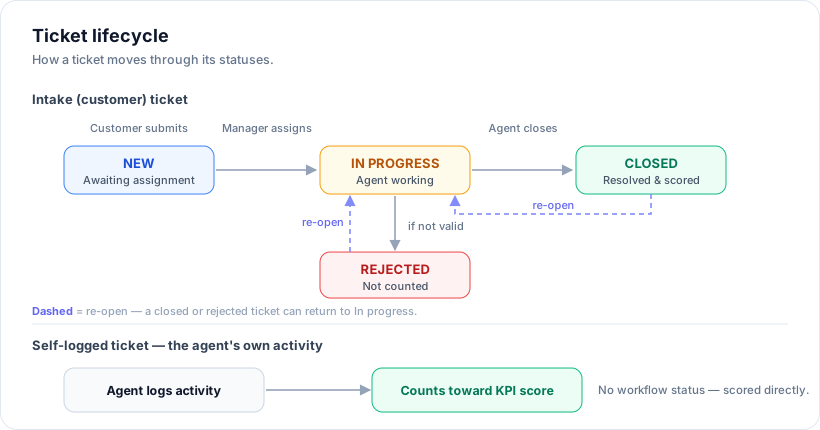
Two kinds of tickets
| Kind | How it gets there | What you do |
|---|---|---|
| Intake ticket | A customer (internal or external) filed it via the Submit Ticket page. An admin assigned you, or you were picked at submission. | Chat with the customer, do the work, mark it Closed. |
| Self-logged ticket | You create it yourself for work you've already done (the kind that counts for KPI scoring but didn't come through intake). | Open the New Ticket form, fill the fields, submit. |
Both kinds end up on your My Profile page.
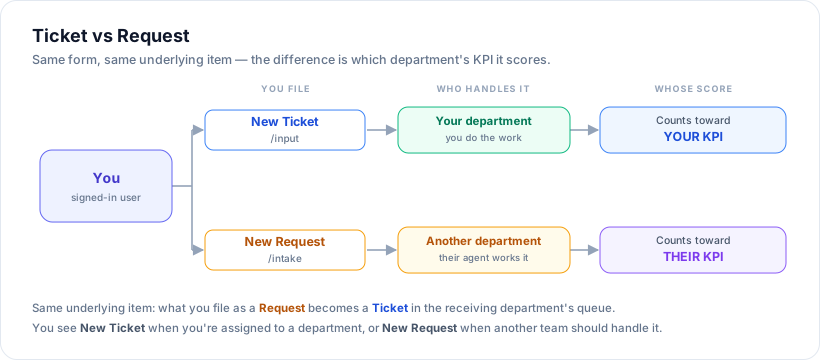
Ticket vs Request — which am I filing?
The create menu in the top nav shows one of two entry points, depending on whether you're filing work for your own department or asking another one to do it:
New Ticket (/input) | New Request (/intake) | |
|---|---|---|
| What it's for | Work you own and log in your own department | Something you ask another department to do — you're the requester |
| Whose KPI it scores | Yours | Theirs |
| What happens next | Scored directly (self-logged), or you work it New → In progress → Closed | Lands in their queue as a New intake ticket; their manager assigns it and their agent closes it |
It's the same underlying item — what you file as a request is simply a ticket in the receiving department's queue, seen from the other side. You'll see New Ticket when you're assigned to a department, and New Request when you have none of your own (or whenever another team should handle the work).
Self-logging a ticket
- Click New Ticket in the top nav.
- Pick the Ticket Date with the date picker.
- Pick your KPI Type — the picker is grouped by KPI Group; only types your department is allowed to log appear.
- Fill the metric fields the type requires:
- rr (response/resolution rule): response time (min), resolution time (min).
- rr-dynamic (Ad Hoc with an extendable deadline): same as
rr, plus a Resolution Deadline (working days) you set per ticket (it defaults from the KPI Type). Raise it later to extend — you must give a reason and the requestor is emailed automatically. Note: these tickets count toward the month they are resolved, not the month requested. - submit (cutoff rule): submit time (hh:mm).
- project (project count): a number.
- accuracy: response accuracy %, data accuracy %.
- acr (1-5 scores): FRT, Attendance, Finding, Backlog, Teamwork, Obedience. You also pick the Subordinate you're rating from a dropdown (see Subordinates below) — the free-text description becomes an optional Remarks note.
- IC rules: completion %, find date/time + close date/time, etc.
- IC CCTV Ad Hoc: for tickets that came in from a customer (intake), the working-day SLA is timed automatically from when you were assigned the ticket to when you close it — the Start/Finish inputs are hidden, and the ticket isn't scored until it's closed. Only IC-logged (non-intake) CCTV Ad Hoc tickets still ask for Start/Finish manually.
- If the date is a weekend or a recorded holiday, the form warns you. Tick "Count as weekend/holiday work" if it should still count toward KPI scoring; otherwise leave it off and the ticket will be excluded.
- Click Submit Ticket.
The form remembers your country/department from your assignment — you don't pick those.
Bulk import from a spreadsheet
To log many tickets at once, use Import tickets on your profile (next to My Tickets):
- Download template — you get an
.xlsxwith one tab per KPI type in your department. Each tab lists the columns that type needs (Ticket Date is required; your name/country/department come from your login, so they're not in the sheet). - Fill one row per ticket in the matching tab. Leave a tab empty if you have nothing for it.
- Upload the file and click Preview — you'll see, per row, whether it's ready or has an error (bad date, missing required value, wrong tab).
- If there are no errors, click Import to create them. Import only creates tickets; re-uploading the same file makes duplicates.
For ACR, put the subordinate's name in the Description column — on import it's matched to your roster (or added if new), so you never need an internal id (see Subordinates below).
No template to download? If the page says "… has no KPI types assigned" instead of showing the Download template button, your department has no KPI types of its own to import. For a parent department (one with sub-departments), the KPI types live on the sub-departments, so there's nothing to log here — file under the sub-department instead, or ask an admin if you expected to import.
Subordinates — rating your team (ACR)
If you're a supervisor, some KPI types (notably ACR — Agent Conduct Rating) score a person on your team who isn't a system user. Those people live in a small roster you manage, so each one keeps a stable identity and a performance history across months — even if their name is typed slightly differently over time.
Managing your roster
Open Subordinates in the top nav (under your account). You'll see everyone you rate.
- Add — type a name and click Add. (You can also add one on the fly from the ACR form's + Add button.)
- Rename — fixes a typo or a name change without losing history; the new name then shows everywhere.
- Mark as left — when someone leaves the team, mark them. They drop out of the input picker from then on, but all their past scores stay for history.
- Reactivate — clears the leave date if they come back.
Status is driven by dates, not a manual on/off switch: a subordinate is active until you mark them as left.
Rating a subordinate (ACR)
When you log an ACR ticket (New Ticket → pick the ACR KPI type):
- Pick the Subordinate from the dropdown. It lists the people who were active on your team in the ticket's month — so you can still rate someone for a month they worked, even after they've since left. Not in the list yet? Use + Add.
- Enter the six 1-5 ratings (FRT, Backlog, Finding, Teamwork, Obedience, Attendance).
- Remarks is optional — a note about the month, not the person's name.
- Submit. The score is the weighted average of the six ratings.
Seeing one person's history
Click a subordinate's name — on the Subordinates page, in My Profile → My Subordinates, or in a monthly drilldown — to open their history: a month-by-month score trend plus the per-component breakdown. (VD members also get a Purchase Achievement trend here.)
Handling an intake (customer) ticket
You get a ticket when:
- Customer picked you directly at submission, or
- An admin assigned the pending ticket to you.
You'll get an email "Ticket assigned: …" with a link.
From My Profile
- Open My Profile → My Tickets tab.
- Tickets show their Status badge (New / On Progress / Closed).
- Click the pencil icon on a row to open the ticket edit page.
The ticket edit page
The page has two halves:
- Edit form — Ticket Date, Department, KPI Type, Description, Status. The metric fields for responseTimeMin and resolutionTimeMin are hidden on intake tickets — they auto-fill (see below). You can change the Status dropdown forward only: New → On Progress → Closed. Going back is not allowed.
- Discussion — chat with the customer. Two badges at the top:
- First response — how long after assignment your first reply landed.
- Resolution — how long after submission the ticket was closed.
Replying to the customer
Type a message in the Discussion box, optionally attach one photo, and click Send.
- Your first reply automatically writes the First Response time into the ticket metrics. If the ticket was New, sending also flips it to On Progress.
- The clock for First Response starts when you were assigned the ticket, not when the customer submitted it. So time spent in the unassigned queue doesn't count against your response time.
- The customer sees your reply on their status page the next time they refresh.
Closing a ticket
Two paths:
- Chat first, then close: chat normally, then on the edit form set Status to Closed and click Update Ticket. The system records the close time and writes the Resolution metric.
- Close without chatting (e.g. you handled it offline / a quick fix): on the edit form set Status to Closed and click Update Ticket. The system treats the close itself as your first response — both First Response and Resolution get the same duration.
A closure email is sent to the customer.
After closing or rejecting
The Update Ticket form locks once the status is Closed or Rejected. You'll see a banner explaining that field updates are locked. You can still send chat messages on a closed ticket if needed.
If you closed or rejected something by accident, click Re-open Ticket to move it back to On Progress. The requestor is notified by email, and you can update the details as needed.
How your score is calculated
Each ticket type has a Rule that decides what counts as a pass. Common ones:
- rr — both response time and resolution time must be within their SLA targets (set per KPI Type by an admin). Score = weighted average.
- rr-dynamic — like
rr, but the resolution target is the ticket's own working-day deadline. If you extended it, the latest deadline is what counts. The ticket scores in the month it was closed. - acr — six 1-5 ratings; the weighted average becomes the score.
- accuracy — response accuracy % and data accuracy % vs. their targets.
- submit — the submit time must be earlier than the cutoff for that day.
Working hours and your country's holiday calendar are honored for time-based calculations. Tickets dated on a weekend or holiday are excluded unless you ticked "Count as weekend/holiday work".
You can see your aggregated scores under My Profile → Monthly Performance with breakdowns by KPI group and KPI type.
Frequently asked
I can't see a KPI Type that I should be able to log. Your department admin hasn't assigned that KPI Type to your department yet. Ask an admin.
A ticket I closed yesterday shows "Not recorded" for First Response. The chat never recorded a first reply (the messages may have come from a path that didn't trigger it). New tickets going forward record it correctly; legacy tickets can be backfilled by an admin running a script.
Can I reassign a ticket to someone else? Not yourself, but your department manager (or an admin) can — they reassign it to a teammate in the same department from My Team → Assigned tickets. Ask them to move it; the new owner is emailed and their response/resolution clock restarts.
Can I edit a closed ticket's description? No — closed tickets lock all fields. The chat stays open.
My weekend ticket isn't counting. Either tick "Count as weekend/holiday work" on the ticket, or have it dated to a working day. Without the tick, working-day filter excludes it.